


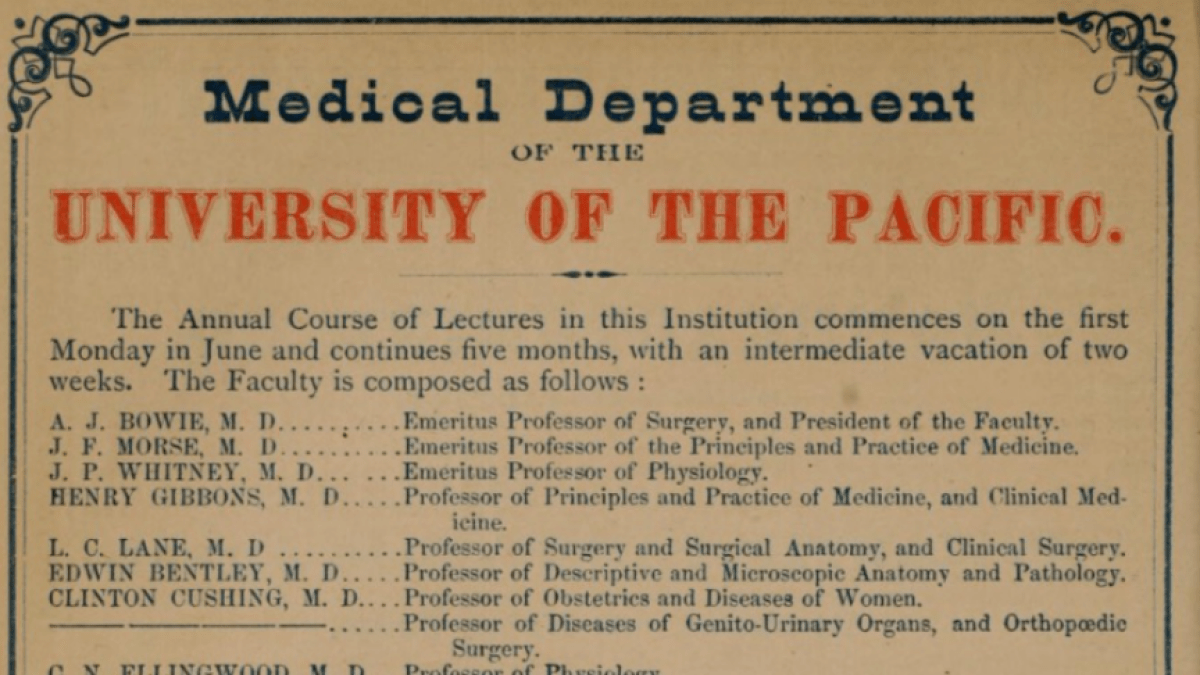
- University of the Pacific founded the first medical school west of Missouri in 1858 — just seven years after the university itself was established as California's first chartered college in 1851.
- The inaugural class consisted of four faculty members and 13 students; 44 students would ultimately graduate from the program.
- The medical department's legacy continues to shape Pacific's identity as a pioneer in professional education across multiple disciplines, from pharmacy to law.
Medical Department Established: 1858, San Francisco
Inaugural Faculty: 4 professors
First Enrolled Students: 13
Total Early Graduates: 44 students
In an era when the American West was still largely defined by the Gold Rush, frontier settlements, and improvised medical care, one small college in California made a decision that would alter the trajectory of healthcare across an entire region. University of the Pacific (Pacific Tigers), already distinguished as California's first chartered institution of higher education, established the first medical school west of Missouri in 1858 — fewer than 10 years after its own founding. At the time, the entire United States had fewer than 50 medical schools. None existed west of the Missouri River.
This is not merely an institutional trivia point. The founding of Pacific's Medical Department in San Francisco marked a turning point in how the Western states would train physicians, treat patients, and build the professional infrastructure that eventually made California one of the most medically advanced regions in the world. Understanding this history is essential for appreciating the university's broader mission — a mission that continues to prioritize professional education, community health, and interdisciplinary innovation nearly 175 years later.
Why Did Pacific Establish a Medical School in 1858?
The context of mid-nineteenth-century California is crucial. By the late 1850s, San Francisco had transformed from a modest port town into a booming city of tens of thousands, driven by the Gold Rush that began in 1848. With rapid population growth came urgent public health challenges: infectious disease outbreaks, industrial injuries from mining and construction, and a severe shortage of trained physicians. The nearest medical schools were thousands of miles to the east, and the journey by land or sea made it impractical for aspiring Western doctors to seek training and return to practice.
Pacific's leadership recognized this gap. According to the university's newsroom account published on May 28, 2026, the school launched its "Medical Department" in San Francisco with four faculty members and 13 students in its inaugural class. The program would ultimately produce 44 graduates — a modest number by today's standards, but a transformative cohort in a region where trained physicians were desperately scarce. These early graduates became foundational figures in Western medicine, establishing practices, hospitals, and medical norms in communities that had previously relied on untrained practitioners or none at all.
The decision also reflected a broader institutional philosophy. Pacific was not content to remain a small liberal arts college. From its earliest years, the university demonstrated a willingness to expand into professional fields where societal need was greatest — a pattern that would repeat itself across the decades that followed.
How Did the Medical Department Shape Western Healthcare?
The significance of Pacific's Medical Department extends well beyond the campus itself. In the years following its founding, the program trained physicians who fanned out across California, Oregon, Nevada, and other Western territories. At a time when medical education nationally was still inconsistent — many programs lacked clinical training or standardized curricula — Pacific's early medical school helped establish professional standards for the region.
The school operated during a period of enormous change in American medical education. The mid-to-late nineteenth century saw the rise of the university-affiliated medical school model, which would eventually supplant the proprietary schools that dominated earlier decades. Pacific's decision to house its medical program within a university framework was ahead of the curve, aligning with what would become the nationally accepted standard after the Flexner Report of 1910 reshaped medical education across the country.
Though the Medical Department's original form did not persist indefinitely at Pacific, its legacy proved durable. The institutional DNA — a commitment to training healthcare professionals within a university setting — carried forward into Pacific's later development of its renowned Thomas J. Long School of Pharmacy, which has consistently ranked among the top pharmacy programs in the nation. In recent years, Pacific has continued this trajectory with a new medical education partnership that reconnects the university to its foundational role in physician training.
What Does This History Mean for Today's Pacific Students?
For current and prospective Pacific students, this history is more than archival material — it is a living framework. The university's willingness to launch a medical school in 1858 with just four faculty members and 13 students speaks to a culture of institutional courage and responsiveness to community need. That same culture is visible today across Pacific's three campuses in Stockton, San Francisco, and Sacramento.
Pacific's San Francisco campus remains home to the Arthur A. Dugoni School of Dentistry, one of the most respected dental programs in the country. In Sacramento, the McGeorge School of Law continues to earn national recognition — including a top ranking in alternative dispute resolution that underscores the school's commitment to innovative legal education. Across all three campuses, Pacific's professional programs share a common heritage with that 1858 Medical Department: the conviction that a university's purpose includes preparing graduates for direct, meaningful professional service.
Students in Pacific's pre-health and biological sciences programs often cite the university's healthcare legacy as a factor in their enrollment decision. The historical connection to medical education lends credibility and institutional depth to Pacific's advising pipelines, research opportunities, and clinical partnerships — resources that are particularly valuable for students from California's Central Valley, a region with persistent physician shortages that echo, in some ways, the conditions that motivated Pacific's original medical school.
Where Does Pacific's Medical Legacy Fit in the National Landscape?
 Nationally, the founding of the first medical school in the Western United States is a milestone that is sometimes overlooked in broader histories of American medical education. Institutions like Harvard Medical School (founded 1782) and the University of Pennsylvania School of Medicine (founded 1765) dominate the historical narrative. But Pacific's 1858 Medical Department filled a geographic and demographic void that Eastern institutions could not address. The Western states were growing faster than any region in the country, and Pacific's early entry into medical education helped ensure that growth was accompanied by professional healthcare capacity.
Today, as conversations about healthcare access and physician distribution continue to dominate national policy debates, Pacific's historical role takes on renewed relevance. The Association of American Medical Colleges has consistently documented physician shortages in rural and underserved communities — precisely the kinds of communities that Pacific's earliest medical graduates served. The university's continued investment in health sciences education, including pharmacy, dentistry, and its expanding medical partnerships, positions it as an institution that has been grappling with healthcare access challenges for nearly 170 years.
For alumni and supporters of Pacific, this history is a point of genuine institutional distinction. If your family has a multi-generational connection to the university, wearing that connection proudly is part of the tradition — something as simple as the Always A Tiger Burns Tower T-Shirt — a Zeus Collegiate exclusive featuring Pacific's most iconic landmark — can spark a conversation about a university whose contributions to Western healthcare and professional education run deeper than most people realize.
What's Next for Pacific's Health Sciences Mission?
Looking ahead, Pacific's leadership under President Christopher Callahan appears committed to building on the institution's healthcare legacy. The university's recent moves to establish new medical education pathways signal an intent to reclaim and modernize the role it pioneered in 1858. Combined with its established strengths in pharmacy, dentistry, and pre-health undergraduate programs, Pacific is positioned to be a comprehensive health sciences university with a scope that few institutions of its size can match.
The broader West Coast Conference (WCC) ecosystem — which includes research-intensive institutions like Gonzaga, Santa Clara, and San Francisco — provides a peer context in which Pacific's professional programs are a distinguishing asset. While many WCC schools are recognized primarily for their liberal arts and business programs, Pacific's deep roots in health sciences give it a unique niche and a compelling narrative for student recruitment, philanthropic investment, and national visibility.
The story of four faculty members and 13 students in 1858 San Francisco is not simply a chapter in a university archive. It is the foundation on which Pacific has built a nearly two-century commitment to training professionals who serve their communities. As the university continues to expand its health sciences portfolio, that founding story grows more relevant — not less.
